


Analysis of bridge condition changes within an automated digital twin using Structural Health Information Patterns (SHIPs)
The condition of aging bridges changes slowly. Damage that has been initiated often progresses unnoticed over a certain time. TwinSHIP attempts to address this problem by bundling useful information from heterogeneous monitoring and inspection sources into an automated digital twin. Within this twin, Structural Health Information Patterns (SHIPs) convert high-dimensional sensor streams into human-interpretable patterns, which indicate when a certain change in condition occurs and help explain why this is happening – whether due to the environment (e.g., temperature), sensor drift, or genuine structural impacts.
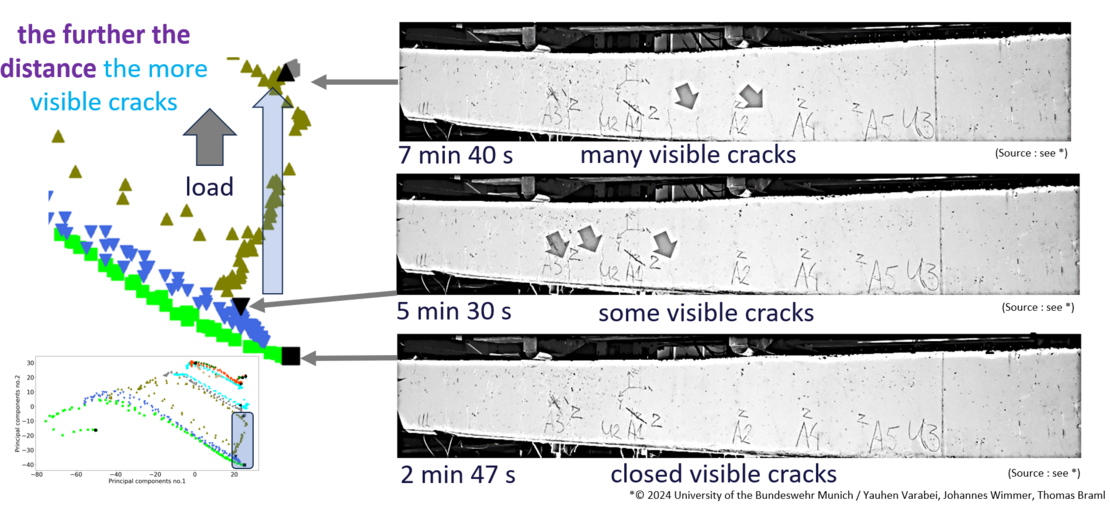
SHIPs combine classic and modern pattern recognition: PCA distil damage-sensitive indicators; CNNs and physically informed models (PINNs) will capture nonlinear behaviour and support forecasting. Previous laboratory and field studies (reinforced concrete beam tests and on-site investigations at the Heinrichsbrücke Bamberg; >13-month data sets) show that PCA clusters separate states, while temperature trending sharpens correlations with actual bridge behaviour. Thus, state changes appear detectable. The challenge is now to trace the changes in data patterns observed in existing structures back to their physical and mechanical causes.
WP 1: Further development of asset administration shells as digital twins for existing bridges
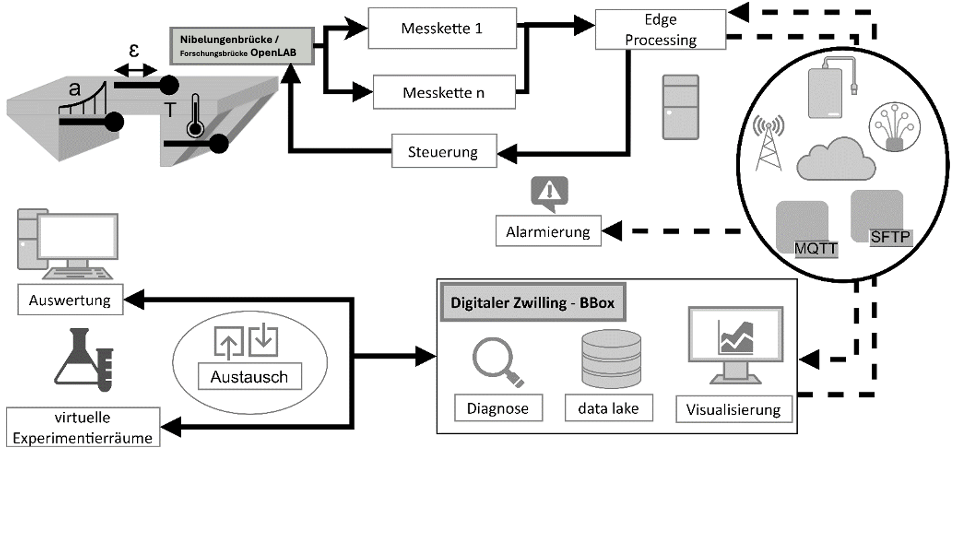
Automated digital twin as a basis for SHIP applications: The heterogeneous structural, environmental, and measurement data are read into asset administration shells over the life cycle and time series stored in InfluxDB with S3 interface to the data lake. The UI will be extended. The automatic generation and operation of a digital twin will be demonstrated.
WP 2: Development of a data structure for pattern recognition and feature extraction
The goal is automated data preparation as the basis for analysis in WP 3. To this end, (1) algorithms for the automated preparation and integration of inspection and monitoring data into the AAS are being developed, (2) methods for the automated generation of training data sets will be established – based, among other things, on published scripts and extensive data sets (e.g., Isenbrücke Schwindegg) as well as data from the Nibelungenbrücke and OpenLAB – and (3) the automated preparation/integration for subsequent pattern recognition will be demonstrated in practice.
WP 3: Pattern recognition for detecting changes in the condition of bridges
WP 3 has three objectives: (1) the automatic detection of changes in condition by SHIPs, (2) the analysis of causes (distinguishing between structural, environmental, and sensor influences), and (3) the derivation of optimized inspection and monitoring concepts. To this end, a SHIP algorithm with CNN-based feature extraction will be implemented and integrated via the open interface from WP 1, physical and mechanical influencing factors will be integrated into the evaluation, and the quantifiability of condition changes and causes will be demonstrated (including target/actual comparison with data from the Isen Bridge). Sensitivity analyses will be used to optimize the strategy.
WP 4: Integrating pattern recognition using SHIPs into existing digital twins
The SHIP method, which was further developed and automated in WP 3, will be integrated into the existing digital twin. The integration is bidirectional: incoming data flows in real time to the twin; recommended actions and analysis results are output and visualized in the twin. The performance is demonstrated using two demonstrators: Nibelungen Bridge Worms and OpenLAB Research Bridge within the SPP twin.
Team



Publications
Wimmer, J., Braml, T. u. Kaiser, M.: Digitale Zwillinge für Brücken mittlerer Stützweite – Pilotprojekt Brücke Schwindegg – Teil 2: Verwaltungsschale. Beton- und Stahlbetonbau 119 (2024) 3, S. 160–168. doi.org/10.1002/best.202300096