Design Methodology for Cross-Life Structural Health Monitoring with Unknown Damage Process – Optimized Sensor Networks
In recent years, monitoring data-driven structural condition assessment, also known as Structural Health Monitoring (SHM), has gained significant importance. However, the current state of development shows deficiencies. SHM systems are predominantly designed based on expert knowledge and are often implemented reactively, in response to already existing damage. This is because the mechanisms, locations, and timing of damage cannot yet be reliably and universally predicted. The project "Design Methodology for Cross-Life Structural Monitoring with Unknown Damage Process" addresses this research gap by conducting fundamental research on the conceptualization of monitoring systems. The aim is to enable reliable monitoring of critical points in infrastructure structures before damage occurs.
During the first funding phase (2022-2025), methods were researched to predict potential damage scenarios for structures with no known prior damage, and to determine physical parameters required for monitoring them. Two approaches were investigated in this context: (1) a cluster-based approach, which predicts damage to the specific structure under investigation by systematically evaluating similar bridge structures and (2) an object-based approach, which identifies critical structural points by analyzing the specific structure. It was recognized that physical quantities that do not reference the detecting sensor or the damage characteristics derived from them provide no usable information about a structure's condition. Furthermore, it was determined that the entire decision-making chain in SHM contains unavoidable uncertainties that influence the reliability of damage identification. Against this background, funding phase 2 will pursue a holistic, probabilistic approach to the design process. The project goal in funding phase 2 is to develop a design methodology that considers the uncertainties of the damage identification process and optimizes the design of sensor networks. Considering the economically driven decision-making processes of infrastructure operators, optimization is carried out with an integrated cost-benefit approach.
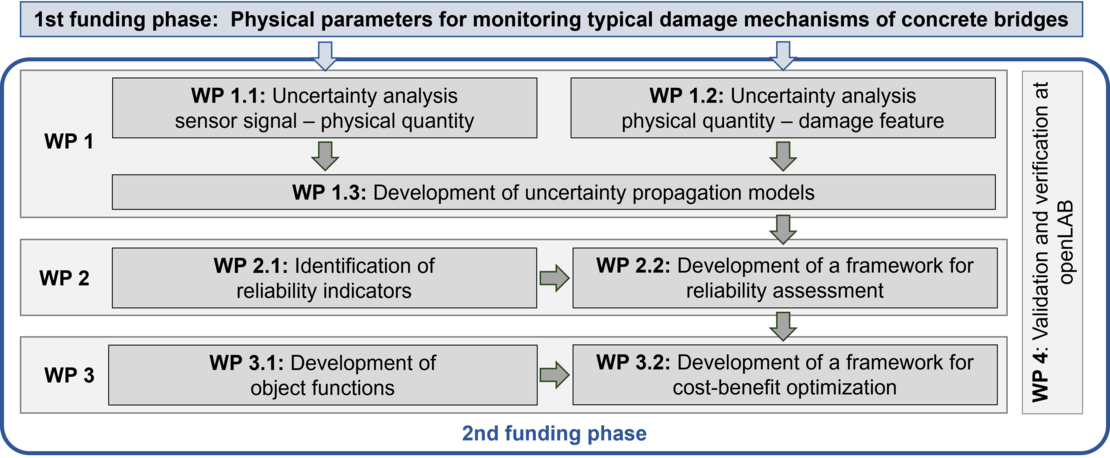
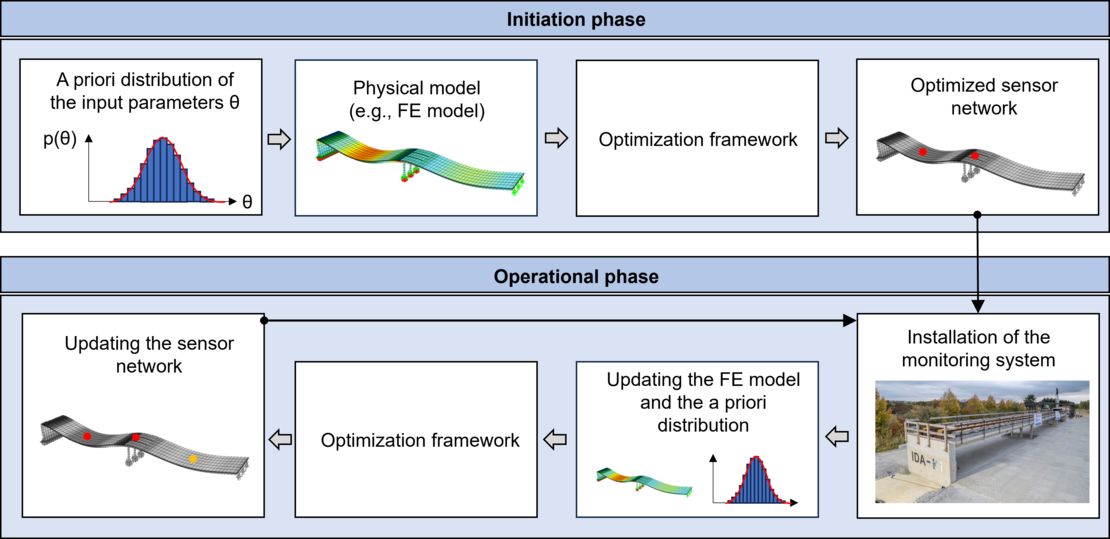
Within the framework of the project, all uncertainties in the damage identification process chain — from raw data acquisition by the measurement system to damage-relevant feature extraction — are first systematically identified, classified, and quantified. This involves analyzing the effects of environmental conditions, measurement systems, and numerical models on the assessment of structural condition, as well as how these uncertainties propagate throughout the entire monitoring chain. Based on these findings, a framework is developed for the reliability assessment of sensor networks. This framework enables the evaluation of the probability and accuracy of damage detection, localization, and prognosis for specific damage cases and sensor networks. Additionally, methods for optimizing sensor networks are developed with a focus on maximizing information value while reducing investment risk. The optimization is carried out in a two-stage process. First, an initial monitoring system is designed in an initiation phase based on a priori information. Second, in the operational phase, the sensor network is iteratively updated based on real measurement data to maintain the required reliability level throughout the bridge's entire service life.
The developed methods are tested and validated under real conditions at the openLAB research bridge. This process employs various sensor systems and damage scenarios. Insights from these experiments are then used to refine the design methodology.