Objective of the Priority Program and the Funding Phase
A structure's condition is characterized by increasingly rapid degradation as it ages. The earlier preventive measures are taken, the more successful they are. To extend the service life of complex structures, significantly more information is needed at an earlier stage than is currently common. To drastically reduce this deficit and achieve predictive maintenance, fundamental research is needed on methods for recording, linking, and evaluating all data related to geometry, materials, loads, and aging. The overarching goal of the SPP 2388 “Hundred Plus” (short: SPP 100+) project is to fundamentally and conceptually realign the current maintenance strategy for infrastructure structures. The SPP 100+ addresses these challenges through three interdisciplinary research areas: Digital Models, Digital Linking, and Condition Indicators, with the first funding phase focusing on the topic groups (1) "Digital Models" and (2) "Digital Linking".

Building on the findings of funding phase 1, phase 2 will focus on two research priorities in research area (3) “Condition Indicators”:
(a)Condition indicators and prognostic models. Scientific methods for evaluating inventory and condition information, such as measurement, diagnostic, and inspection data, as well as their linking to real structures, are addressed. Representative damage mechanisms and models, as well as degradation processes in steel and prestressed concrete and steel (composite), will be given particular focus. The information generated from various data sources will be consolidated to form the basis for developing specific condition indicators and prognostic models.
(b)Methods for deriving recommendations for action. Based on existing inventory and condition information, methods are developed to derive action recommendations aimed at the predictive and prescriptive maintenance of structures. Systematic management and automated evaluation of historical and current measurement data, as well as structural information are essential. The resulting knowledge bases are linked with the recommendations in a digital twin and presented graphically.
The condition indicators and prognostic models developed, as well as the methods developed for deriving recommendations for actions, will be tested and validated on real structures. For this purpose, the coordination project provides two bridges in funding phase 2: the Nibelungen Bridge in Worms as an existing structure with deficits in shear capacity and corrosion of the tendons, and the openLAB as a research bridge, where destructive tests can be carried out to validate sensor concepts and damage identification strategies.
Accompanying Research
In the coordination project, intensive accompanying research was carried out in the first funding phase to establish the Nibelungen Bridge as a demonstrator. As-designed and as-built models, a Structural Health Monitoring (SHM) system, and a comprehensive data exchange platform were developed.
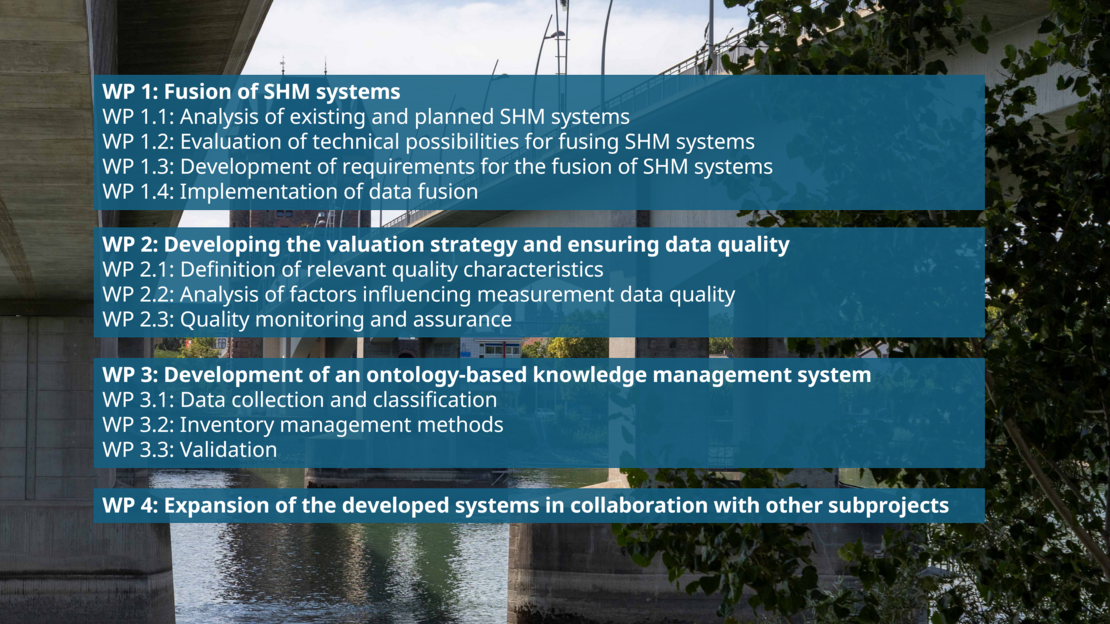
Phase 2 focuses on integrating the various SHM systems developed in phase 1 and phase 2 by the subprojects to create a fused, collaborative SHM system. For this purpose, the existing data platform, including the initial SHM system of SPP 100+, will be further developed in phase 2 to meet growing requirements. In addition, an enhanced user interface will be developed to enable easier navigation and improved user experience. This will allow experienced researchers as well as new users to easily access and analyze the data. In parallel, methods will be developed to ensure the quality and reliability of all generated data. Furthermore, a strategy for intelligent knowledge management will be developed. This strategy will not only include existing documents but also integrate monitoring data to create a holistic approach to knowledge management. Four work packages (WPs) are planned to implement the above-mentioned objectives (see Figure 2).